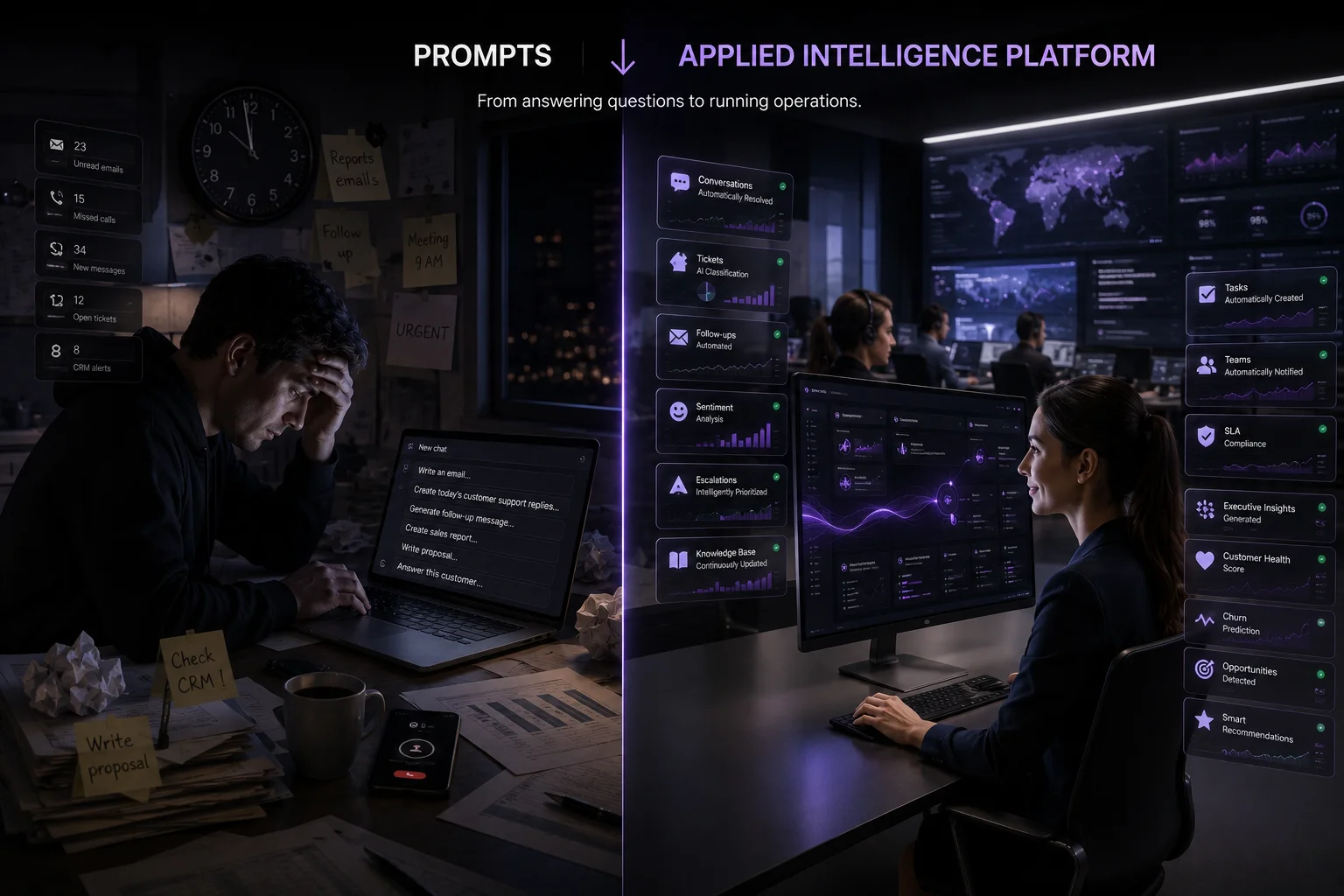
Introduction
In the rush to adopt artificial intelligence, most enterprise software vendors made a fundamental design error: they took traditional, passive databases and slapped a chatbot on top.
The result? Executives now have a fancy conversational interface to ask questions about outdated CRM data. But asking an AI "What was our Q2 conversion rate?" doesn't fix a broken deal pipeline, nor does it prevent churn. The enterprise world doesn't suffer from a lack of text generation; it suffers from an execution bottleneck.
The Three Generations of Enterprise AI
To understand where enterprise architecture is headed, we must look at how intelligence has been applied over the last decade:
[ Gen 1: Predictive AI ] ──> [ Gen 2: Generative AI ] ──> [ Gen 3: Applied Intelligence (AIP) ]
(Static Dashboards) (Prompts & Chatbots) (Autonomous Orchestration)
Generation 1: Predictive Analytics (The Spectator)
Focus: Charts, graphs, and probability scores.
The Flaw: It tells you what might happen, but leaves you to figure out what to do next.
Generation 2: Generative AI (The Co-pilot)
Focus: Text generation, email drafting, and query answers.
The Flaw: It requires constant human prompting and supervision. It assists, but it doesn't own the outcome.
Generation 3: Applied Intelligence Platform - AIP (The Operator)
Focus: Continuous contextual awareness, real-time decisioning, and autonomous workflow execution.
The Advantage: TIA operates silently across your enterprise stack, bridging the gap between insight and action.
How TIA Replaces the Prompting Loop
When enterprise intelligence is truly applied, human operators no longer spend their days typing prompts into a side panel. WONTIA AIP changes the dynamic entirely:
From Manual Queries to Contextual Awareness (UNDERSTAND):
Instead of waiting for a user to upload a meeting transcript, TIA continuously ingests cross-platform telemetry—email sentiment, calendar pacing, deal velocity, and ERP telemetry—building an active semantic map of the business.
From Assistant Suggestions to Autonomous Deciding (DECIDE):
Rather than giving you 5 options to choose from, TIA evaluates operational friction, flags revenue risks, and formulates the single optimal decision based on enterprise goals.
From Chat Output to Direct Execution (EXECUTE):
TIA doesn't write a draft and ask you to copy-paste it. It updates underlying systems, reallocates team bandwidth, triggers targeted workflows, and logs the execution autonomously.
Conclusion: The Future Belongs to Autonomous Execution
Chatbots were a helpful stepping stone, but prompts are the new data-entry forms—just another manual task standing between you and your business objectives.
The future of enterprise software is not a smarter chat window; it is an intelligent operational backbone that understands context, decides with precision, and executes without friction.