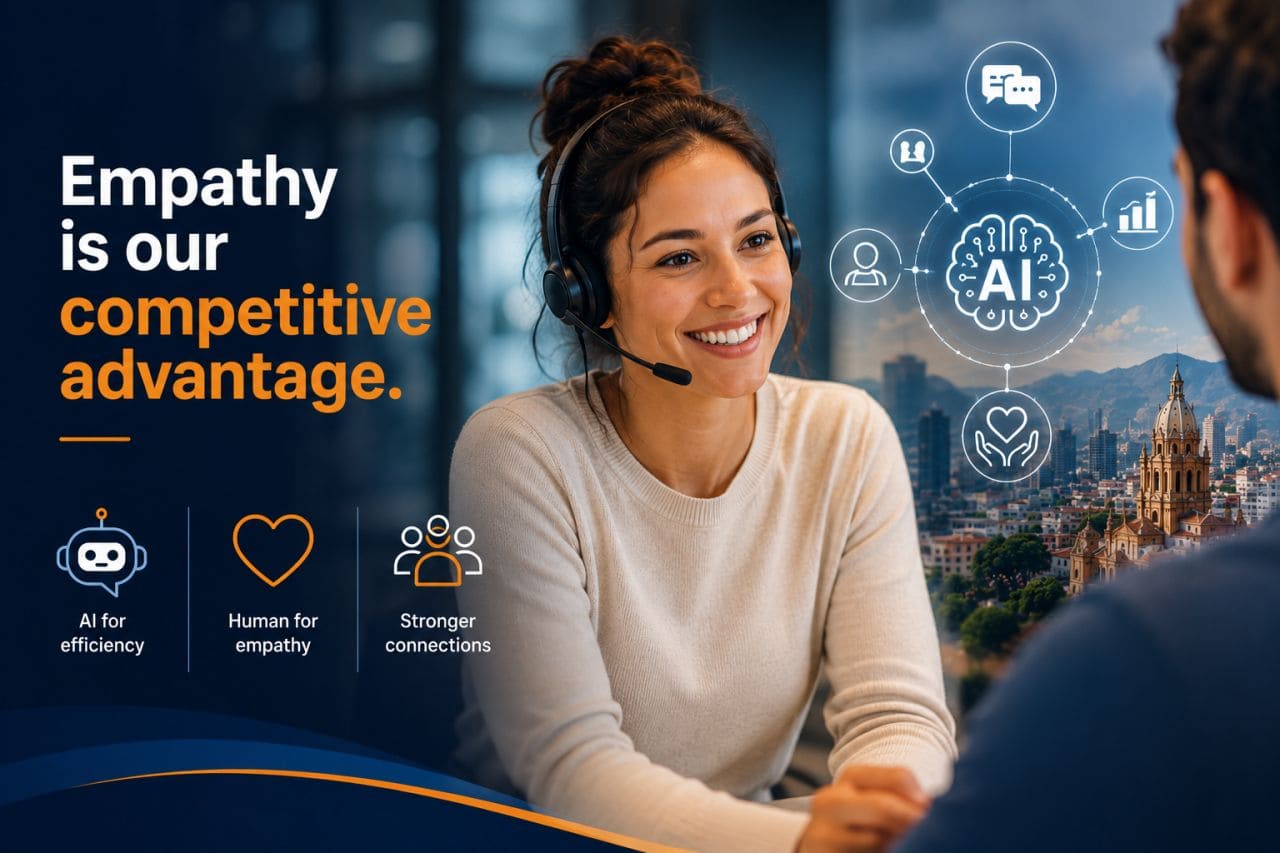
The customer experience landscape is undergoing a tectonic shift. Recent headlines trumpet the expansion of AI capabilities across platforms, the rise of no-code AI agents, and the integration of generative AI into every corner of the CX stack. Yet beneath the surface of these technological leaps lies a more profound question: Are we building experiences that customers actually feel, or just faster pipelines for resolution? The answer, for forward-thinking enterprises, is no longer about choosing between human and machine—it's about architecting a new kind of empathy, one that leverages AI to amplify, not replace, the human touch.
The Paradox of AI-Enhanced CX
Every major CX platform, from 8×8 to RingCentral and Microsoft, is embedding AI into their core offerings. The promise is seductive: predictive routing, real-time sentiment analysis, and autonomous agents that resolve issues before a customer even articulates them. But here's the paradox—as AI handles the mundane, the repetitive, and the predictable, the moments that truly define a brand's relationship with its customers become increasingly rare and increasingly valuable. When a customer does escalate to a human, it's because the situation is complex, emotionally charged, or uniquely personal. In those moments, the agent's ability to listen, to understand nuance, and to respond with genuine empathy becomes the ultimate differentiator. The question is not whether AI can replace that, but whether your operational model is designed to let it flourish.
From Transactional to Transformational: The New Agent Role
For years, the BPO industry has been measured on efficiency—average handle time, first-call resolution, cost per contact. These metrics, while useful, have inadvertently trained agents to rush through interactions. The AI era flips this script. With AI handling the 80% of queries that are routine, the human agent's role shifts from transaction processor to experience architect. This requires a fundamental redesign of training, quality assurance, and career progression. Agents must become adept at reading emotional cues, de-escalating frustration, and co-creating solutions with the customer. It's a higher-order skill set, and it demands a workforce that is not just technically proficient but emotionally intelligent. This is where nearshore hubs like Colombia are gaining a distinct edge, offering a cultural alignment and a deep-seated service orientation that resonates powerfully with US consumers.
Designing for the Emotional Journey
Neuroscience is beginning to reveal what great service agents have always known intuitively: emotion drives memory, and memory drives loyalty. A customer may forget the exact resolution time, but they will never forget how a problem made them feel. The most sophisticated CX strategies now apply this insight at scale. They map not just the journey, but the emotional arc of the interaction, identifying moments of frustration, confusion, and delight. AI can analyze sentiment in real time, flagging when a customer's tone shifts from neutral to agitated. But it's the human agent, equipped with that insight, who can pivot the conversation—offering a sincere apology, a personalized solution, or simply a moment of acknowledgment. This is the new architecture of experience: a seamless handoff between machine efficiency and human empathy, orchestrated by design.
The Nearshore Advantage in a Hybrid World
As enterprises grapple with the complexity of this hybrid model, geography matters more than ever. The promise of AI is global, but its execution is deeply local. Cultural nuance, language fluency, and emotional resonance cannot be outsourced to a server. They are the product of human beings who share a cultural context with the customer. This is why Colombia has emerged as a premier nearshore destination for US companies. It's not just the time zone alignment or the high level of English proficiency—it's the cultural affinity, the warmth, and the genuine desire to serve that permeates the workforce. At Marcas BPO, we've seen firsthand how this cultural bridge transforms customer interactions from transactional exchanges into lasting relationships. In a world where AI can simulate empathy, authentic human connection becomes the ultimate luxury.
Conclusion: The Human Imperative
The headlines will continue to announce new AI breakthroughs, but the real story is more nuanced. The future of CX lies not in choosing between artificial intelligence and human intelligence, but in orchestrating a symphony between the two. Are you prepared to redefine your metrics, retrain your agents, and redesign your operations around the moments that matter most? The technology is ready. The question is whether your organization has the vision to see that the most advanced AI feature is, and always will be, the human heart. Those who understand this will not just survive the AI revolution—they will lead it.
This original Marcas BPO editorial was informed by industry reporting from:
• 8×8 Expands AI Capabilities Across CX Platform — Call Centre Helper
• 4 neuroscience-backed tips for using AI to learn more effectively — Fast Company
• Run a free, private, offline AI on your computer to handle repetitive tasks — Fast Company
• Creatio 10x Launches With No-Code AI Agents and Enterprise Governance — TechRepublic
• Big CX News from RingCentral, NiCE, Microsoft, Uber & Meta — CX Today
Content is 100% original. Marcas BPO editorial team independently researched, analyzed, and wrote this article.