Your business may not need more people. It may need better processes.
When companies grow, operational complexity usually grows with them. More customers, more data, more emails, more requests, more administrative work.
But adding people to solve every operational problem isn't always the most efficient answer. The better question is: How much more could your existing team accomplish if unnecessary work disappeared?
The productivity problem is bigger than it looks
Microsoft’s Work Trend Index found that employees spend 57% of their time communicating through meetings, email, and chat, leaving only 43% for creation. Additionally, 68% of people surveyed said they don’t have enough uninterrupted focus time during the workday.
That means valuable talent can spend a significant portion of the day moving information instead of creating value. And the problem goes beyond individual productivity.
McKinsey reports that two-thirds of executives consider their organizations overly complex and inefficient, with processes, data silos, and organizational structures often preventing scalable efficiency.
What operational efficiency can unlock
Improving processes isn’t simply about doing things faster. It can help companies achieve:
More capacity
Automating repetitive tasks and optimizing workflows allows teams to handle greater volumes without increasing headcount at the same rate.
More focus
Employees can spend more time on customers, strategy, innovation, and revenue-generating activities.
Better cost efficiency
Reducing unnecessary manual work can help businesses get more value from the resources they already have.
Easier scalability
Well-designed processes are easier to replicate when entering new markets, adding customers, or increasing demand.
Better use of talent
Specialized professionals can focus on decisions and tasks where human expertise creates the greatest impact.
Technology alone isn’t the answer
Automation can eliminate repetitive work, but successful transformation requires more than technology. Processes need to be redesigned, data needs to flow correctly, and people need to remain involved where judgment, context, and customer relationships matter.
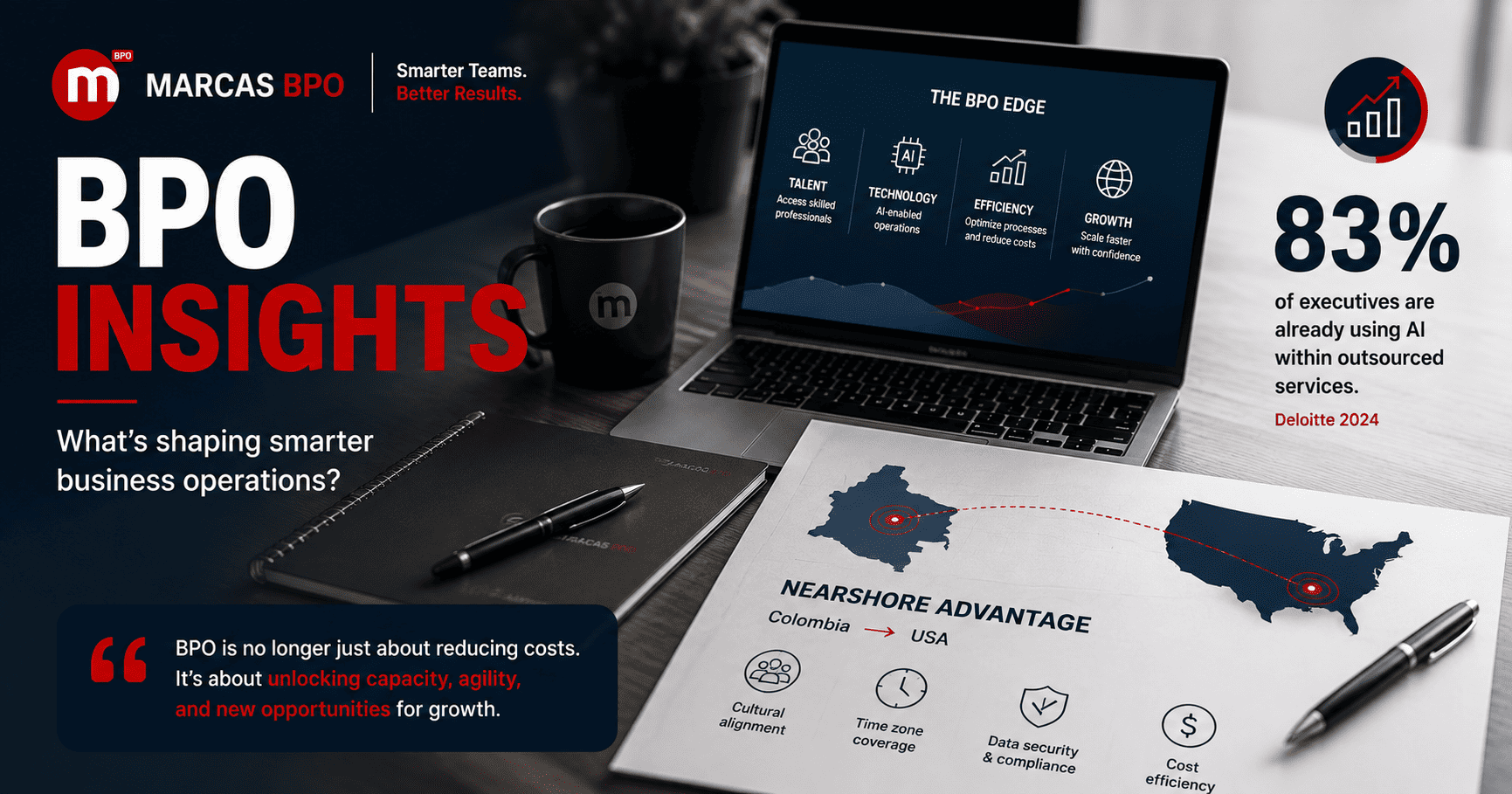
This is why companies are increasingly combining technology with specialized talent. Deloitte’s 2024 Global Outsourcing Survey found that 83% of executives are already using AI within outsourced services, while 80% plan to maintain or increase their investment in third-party outsourcing.
The trend isn’t simply about reducing labor costs. It’s about accessing skills, technology, flexibility, and operational capacity.
The real competitive advantage
Operational efficiency isn’t about making people work harder. It’s about removing the work that shouldn’t require their time in the first place.
The companies that scale successfully will be those that learn to combine technology, processes, and specialized talent to create more capacity without creating unnecessary complexity.
More capacity. Less friction. More room to grow.