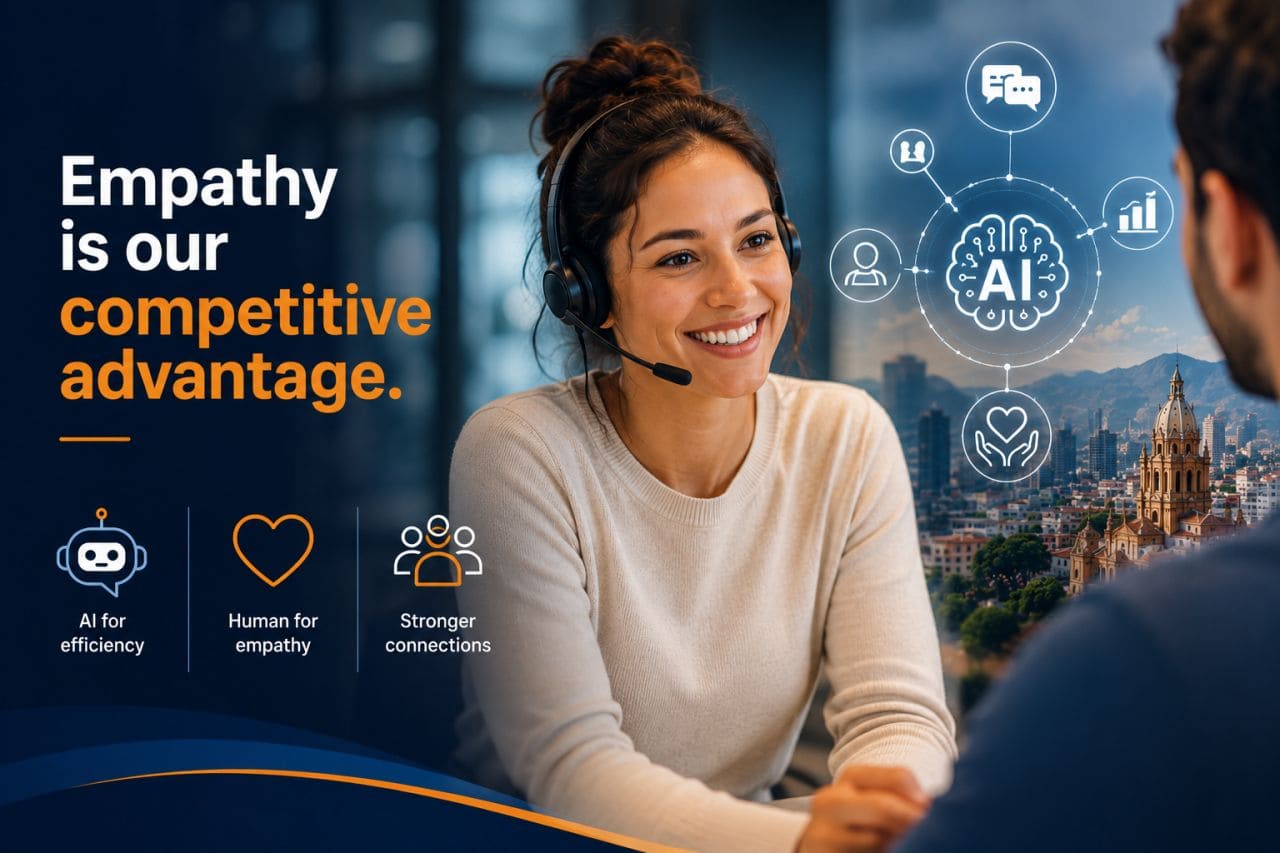
In the relentless pursuit of operational efficiency, many enterprises have embraced artificial intelligence as the panacea for all customer experience (CX) ailments. Yet, the most recent wave of AI announcements—from expanded CX platforms to no-code agents—reveals a more nuanced reality: the technology is merely an enabler. The true differentiator lies in the orchestration of human and machine intelligence. For companies seeking to navigate this complex landscape, the question is no longer 'what can AI do?' but 'how should we integrate it to foster genuine loyalty?' This shift demands a strategic re-evaluation of where and how CX is delivered, with nearshore hubs like Colombia emerging as unexpected but powerful catalysts.
The AI Paradox: More Automation, Greater Need for Empathy
As AI handles routine inquiries with increasing sophistication, the nature of human-agent interactions is fundamentally changing. When a customer finally escalates to a live agent, the issue is inherently more complex, emotionally charged, or high-stakes. This is where the paradox emerges: the more we automate, the higher the premium on genuine human empathy. Companies are discovering that their AI's effectiveness is directly proportional to the quality of the human fallback. This is not a technology problem; it's a talent and culture problem. How do you train a workforce to handle the nuanced, high-emotion interactions that AI cannot? The answer lies in investing in sophisticated soft skills and cultural alignment—attributes that are often more readily found in nearshore environments, where a deep understanding of the US consumer is coupled with a service-first mentality.
Beyond the Algorithm: The Data-Driven Human Touch
The latest AI tools promise unprecedented insights into customer behavior, but data without context is just noise. The most successful CX strategies use AI to surface patterns and predict needs, but then rely on human agents to interpret and act on that intelligence with judgment and warmth. This is where the 'human-in-the-loop' model becomes a competitive advantage. Consider a scenario where AI flags a customer's frustration based on sentiment analysis. A well-trained agent in a nearshore center can leverage that insight to pivot the conversation, offering a personalized solution that a scripted bot never could. This is not about replacing humans; it's about augmenting them with the right information at the right time. The challenge for leaders is to design workflows that empower agents to be decision-makers, not just order-takers.
The Nearshore Advantage: Why Colombia Is Becoming a CX Powerhouse
As this human-centric AI model gains traction, the location of your CX operations becomes a strategic asset. Colombia, with its strong cultural affinity to the United States and a rapidly growing pool of bilingual, tech-savvy professionals, is positioning itself as a premier nearshore destination. Here, companies are not just finding cost-effective labor; they are finding a workforce that can deliver the high-touch, empathetic service that AI demands as a complement. Marcas BPO, for instance, has been at the forefront of this movement, demonstrating that a nearshore partner can provide the agility and cultural alignment that offshore models often lack. In a world where every interaction is a brand moment, having a team that understands the nuances of your customer's world is not a luxury—it's a necessity.
Designing for the Future: A Blueprint for CX Leaders
The path forward requires a deliberate design process that places human experience at the core of AI deployment. It begins with a clear-eyed assessment of which interactions are best suited for automation and which require the human touch. It continues with a commitment to continuous learning, not just for AI models, but for the people who manage them. And it culminates in a culture that celebrates problem-solving over script-following. Are you measuring your CX success by resolution time or by the quality of the emotional connection? Are you equipping your agents with the tools and authority to create memorable experiences? The companies that will thrive in the next decade are those that view AI not as a cost-cutting tool, but as a catalyst for deepening customer relationships. The question is, are you ready to lead that change?
Conclusion: The Human Imperative
The recent wave of AI innovation is not a signal to double down on automation, but rather a call to double down on humanity. As algorithms handle the mundane, the value of human empathy, judgment, and cultural fluency skyrockets. The future of CX belongs to those who can orchestrate this delicate dance between efficiency and emotion. By embracing a nearshore model that prioritizes talent and cultural alignment, companies can turn the AI revolution into a customer loyalty revolution. The technology is ready. Are you?
This original Marcas BPO editorial was informed by industry reporting from:
• 8×8 Expands AI Capabilities Across CX Platform — Call Centre Helper
• 4 neuroscience-backed tips for using AI to learn more effectively — Fast Company
• Run a free, private, offline AI on your computer to handle repetitive tasks — Fast Company
• Creatio 10x Launches With No-Code AI Agents and Enterprise Governance — TechRepublic
• Big CX News from RingCentral, NiCE, Microsoft, Uber & Meta — CX Today
Content is 100% original. Marcas BPO editorial team independently researched, analyzed, and wrote this article.