The race to deploy artificial intelligence in customer experience has never been more urgent—or more fraught with complexity. With regulatory frameworks tightening and consumer expectations soaring, the question is no longer whether to adopt AI, but how to do so with precision, ethics, and a clear-eyed view of the bottom line. For BPO providers and their clients, the stakes are existential: those who treat AI as a mere cost-cutting tool will find themselves outpaced by rivals who see it as a catalyst for deeper loyalty and operational excellence.
The Regulatory Crossroads: Compliance as a Competitive Advantage
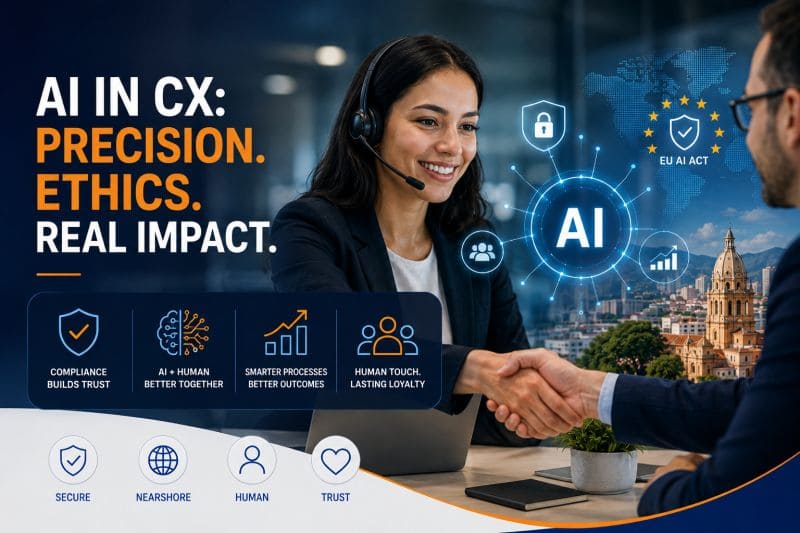
The recent enforcement of the EU AI Act sent a shockwave through global CX teams, and for good reason. While the regulation applies directly to European operations, its ripple effects are felt far beyond—especially for nearshore providers serving US clients. The act’s emphasis on transparency, data governance, and human oversight is not a bureaucratic hurdle; it is a blueprint for trust. In an era where data breaches and algorithmic bias dominate headlines, compliance becomes a market differentiator. BPOs that proactively embed these principles into their AI workflows can reassure clients that their customers’ data is not just secure, but handled with the same rigor as a Fortune 500’s legal department. After all, can any brand afford to ignore the signal that regulators are sending about the ethical use of automation?
Beyond the Hype: AI’s Real Impact on Business Growth
Entrepreneurs and enterprise leaders alike are discovering that AI’s true value lies not in flashy chatbots, but in the unglamorous work of process optimization. Consider the mid-sized company that uses machine learning to predict churn, or the contact center that automates routine queries while flagging complex issues for human agents. These are the quiet wins that compound into million-dollar outcomes. But the path to such gains is littered with pitfalls: over-automation can alienate customers, while under-automation leaves efficiency on the table. The key is to treat AI as a collaborator, not a replacement. In Colombia, a growing hub for nearshore BPO, providers like Marcas BPO are demonstrating that a balanced approach—one that pairs AI’s speed with human empathy—can deliver measurable results without sacrificing the personal touch that customers still crave.
Quality Assurance in the Age of AI: A New Playbook
Traditional quality assurance in call centers relied on random call monitoring and manual scoring—a model that is as outdated as it is inefficient. AI now enables continuous, real-time analysis of every interaction, from sentiment to compliance adherence. Yet, this technological leap brings a paradox: the more we rely on algorithms to judge quality, the more we must ensure those algorithms are free from bias and aligned with brand values. The solution lies in hybrid QA frameworks, where AI flags anomalies and human supervisors interpret context. This is not merely a technical adjustment; it is a philosophical one. Are we measuring what matters—customer outcomes—or just what is easy to measure? The most forward-thinking CX leaders are asking this question daily, and they are finding that the answer often lies in redefining success metrics beyond average handle time and CSAT scores.
Privacy and Trust: The Unspoken Contract with Customers
As AI conversations become more sophisticated, the issue of privacy looms larger than ever. Consumers are increasingly aware of how their data is used, and they reward brands that are transparent. This is not just about complying with CCPA or GDPR; it is about honoring an implicit contract. When a customer interacts with a virtual assistant, they trust that their words will not be misused. BPOs must therefore invest in robust data anonymization, secure storage, and clear opt-in mechanisms. The reputational cost of a breach is far higher than the cost of prevention. And yet, many companies still treat privacy as an afterthought. Why risk losing the very trust that AI is supposed to enhance? In this landscape, nearshore providers in Colombia have a unique advantage: proximity to US markets, coupled with a strong cultural affinity and a legal framework that aligns with Western standards. This combination makes them ideal partners for brands that prioritize both innovation and integrity.
Conclusion: The Human Element Remains Non-Negotiable
Artificial intelligence is not a panacea, nor is it a passing fad. It is a powerful lens through which we can see our customers more clearly—if we choose to look. The brands that will thrive in the next decade are those that use AI to amplify human capabilities, not diminish them. They will build systems that respect privacy, adhere to regulation, and elevate quality. They will also recognize that the ultimate competitive advantage is a workforce that feels empowered by technology, not threatened by it. As you chart your own AI journey, remember: the goal is not to replace the human touch, but to free it from the mundane, so it can focus on what truly matters—building relationships that last. And in that endeavor, a nearshore partner like Marcas BPO, rooted in Colombia’s vibrant talent pool, can be the bridge between automation and authenticity.
This original Marcas BPO editorial was informed by industry reporting from:
• The EU AI Act Deadline Is Here: Why CX Teams Cannot Afford to Wait — CX Today
• 4 Surprising Ways AI Is Helping Ordinary Businesses Reach $1 Million Faster — Entrepreneur
• Are Brands Finally Listening to Social Media Customers? — CX Today
• How to Improve Quality Assurance in a Call Centre — Call Centre Helper
• How to keep your AI conversations as private as possible — ZDNet Innovation
Content is 100% original. Marcas BPO editorial team independently researched, analyzed, and wrote this article.